

October: Tanuki of Oki Islands
October 30, 2026
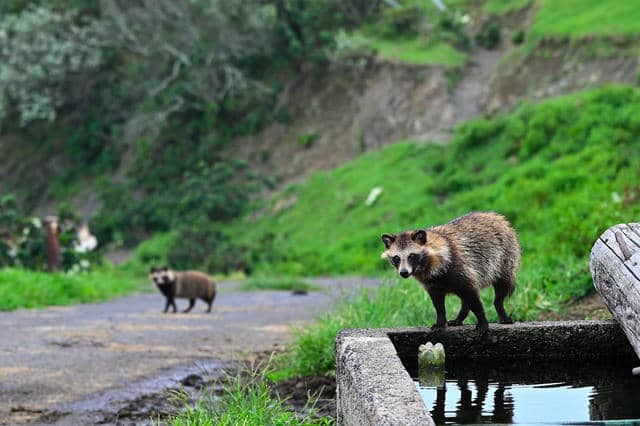
On Chiburi-jima, a chance encounter with a tanuki can be part of an ordinary walk (Photo credit: PIXTA)
Often seen as ceramic figures outside Japanese restaurants, tanuki are familiar characters known for drinking, mischief and shapeshifting—but their real-life counterparts are rather more elusive.
Raccoon dogs, or Nyctereutes procyonoides, are sometimes mistaken for badgers, but actually belong to the canine family. Despite their dog-like classification, they bear little resemblance to the Akita or Shiba Inu you may associate with Japan. Omnivorous and generally nocturnal, tanuki tend to avoid people and are more likely to be glimpsed slipping across a path or heard rustling through the undergrowth.
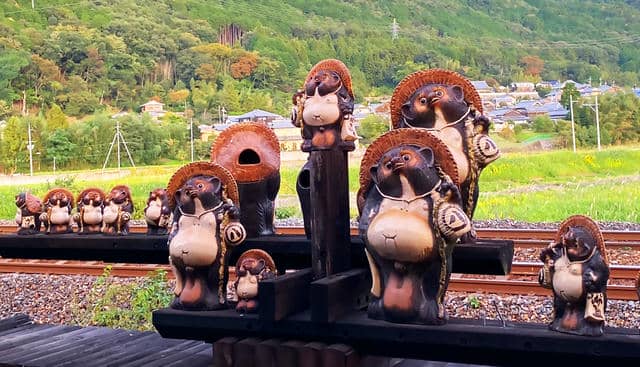
Found across Japan, ceramic tanuki figures give playful form to Japanese folklore, with their exaggerated features bearing little resemblance to the elusive animal itself
Their secretive nature may help explain some of the mystery that has surrounded them in Japanese folklore, where tanuki have long been portrayed as mischievous shapeshifters with a fondness for food, drink and trickery. Their famously exaggerated anatomy is another familiar feature of traditional depictions—though, like their supernatural powers, folklore has taken considerable liberties with the real animal.
If the raccoon dog has piqued your interest, there is one small island in Japan where encounters with tanuki are surprisingly common. Chiburi-jima, the smallest of the four inhabited Oki Islands in the Sea of Japan off the coast of Shimane Prefecture, is thought to be home to more than 2,000 tanuki—far outnumbering its fewer than 600 human residents.
Unlike many of the island’s native inhabitants, however, tanuki are relative newcomers. According to local accounts, a pair were given to the village chief in 1941, escaped, and went on to establish the population found across the island today.
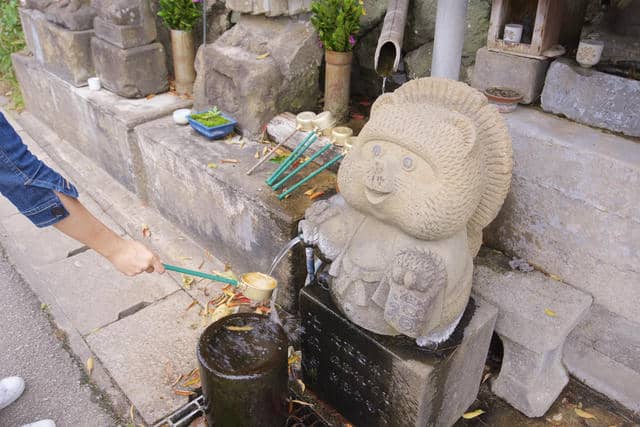
Kawai Spring, one of Shimane’s “Top 100 Exquisite and Well-Conserved Waters,” is still used by islanders today—with a familiar tanuki presence watching over the spring (Photo credit: PIXTA)
Chiburi-jima seems to offer the animals a favorable mix of woodland, farmland and abundant fresh water. Although tanuki are generally nocturnal, they are also frequently seen during the day here, perhaps helped by the absence of natural predators. As a result, visitors exploring the island may encounter them unexpectedly along roadsides and paths.
Beyond its resident tanuki, Chiburi-jima is known for its quiet pastoral landscape. Cattle graze across rolling hills divided by distinctive myogaki stone walls, remnants of the traditional makihata rotational farming system that shaped the island for centuries.
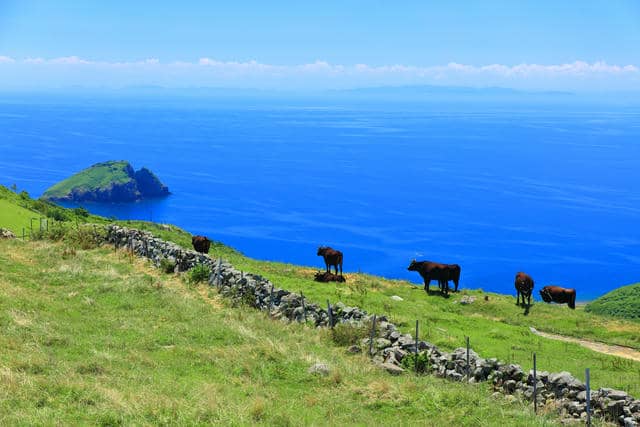
Pastures, grazing cattle and old stone walls tell another side of Chiburi-jima’s story, shaped by centuries of farming on this volcanic island (Photo credit: PIXTA)
From the 325-meter summit of Mt. Akahage, hikers are rewarded with sweeping 360-degree views across the sea-filled Dozen Caldera and neighboring islands. Formed through volcanic activity millions of years ago, this dramatic landscape can also be seen at Sekiheki, or the Red Cliff, where iron-rich volcanic material oxidized on contact with the air, giving the rock its striking red color.
The geology of the wider Oki Islands has shaped more than the scenery. As far back as 30,000 years ago, high-quality obsidian from Oki was transported to mainland Japan and used to make stone tools. Over the centuries, the islands continued to serve as a crossroads for people and cultures, later becoming a place of exile and a port of call for kitamaebune trading ships. These layers of exchange helped shape the distinctive traditions and culture that remain part of Oki life today.
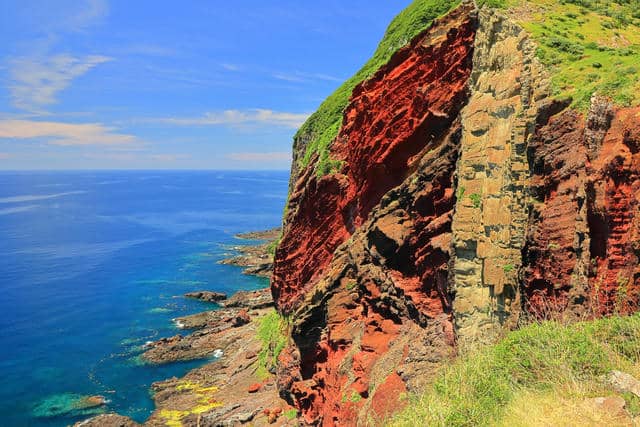
At Sekiheki, or the Red Cliff, layers of iron-rich volcanic rock reveal the fiery origins of Chiburi-jima’s landscape (Photo credit: PIXTA)
Today, a new generation of residents is finding new ways to share island life with visitors. Chez SAWA, a French restaurant set in a traditional Japanese house, serves dishes inspired by the island using locally grown vegetables, herbs and freshly caught seafood. Meanwhile, French-born former chef David Gomez now works as a local geopark guide, introducing visitors to Chiburi-jima’s landscapes and culture through activities such as sea kayaking and guided tours.
Reaching Chiburi-jima takes a little extra effort, but that is part of its appeal. Beyond the tanuki that first draw the curious here lies an island shaped by volcanoes, centuries of human movement and the people who continue to make a life on its shores today. And somewhere along the way, visitors may still encounter a little mischief from one of the island’s resident tanuki.
For more details, contact DMC Japan to discuss ideas, locations and rates.
Contact Us