

August: Misaki Horses at Cape Toi
August 31, 2026
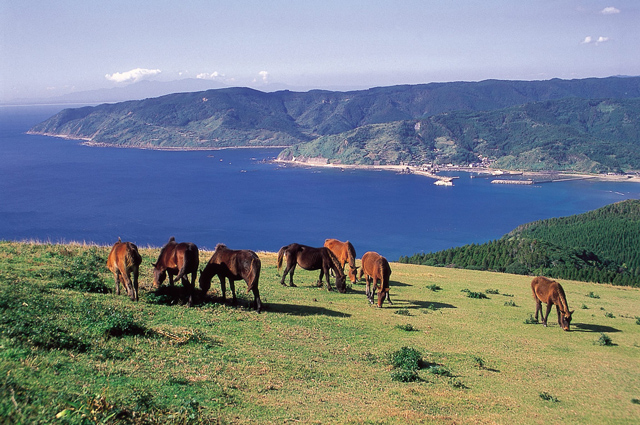
The sweeping grasslands of Cape Toi have been home to the free-roaming Misaki horses for more than 300 years (Photo credit: Miyazaki Prefecture Tourism Association)
Along the rugged coastline of southern Miyazaki, sweeping grasslands meet the Pacific Ocean—and grazing among them are some of the region’s most distinctive residents. The Misaki horses roam freely across the pastures of Cape Toi, their quiet presence an enduring part of this dramatic coastal landscape.
Located at the southern tip of Nichinan Kaigan Quasi-National Park, Cape Toi is a windswept headland in southeastern Kyushu, known for its rolling green hills, rugged coastline and expansive ocean views. It is also home to the Misaki horses, a native Japanese breed that has lived here for generations.
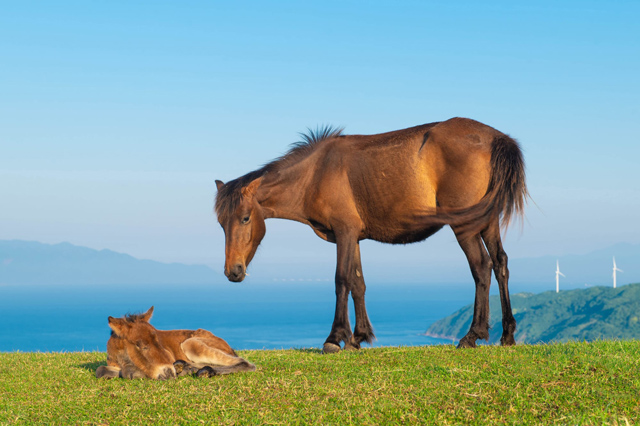
Misaki horses are Japan’s only native horse breed living in a feral state (Photo credit: PIXTA)
Today, just over 100 Misaki horses roam freely across the grasslands of Cape Toi with remarkably little human intervention. They are thought to descend from horses raised at a ranch established by the Takanabe clan during the Edo period (1603–1867), where they have lived for more than 300 years. As horses gradually disappeared from other parts of Japan, the Misaki horses and their breeding grounds were designated a National Natural Monument, helping to preserve one of the country’s few remaining native horse populations.
Of Japan’s eight native horse breeds, the Misaki horse is the only one still living in a feral state. Observing them respectfully is an important part of visiting Cape Toi. Visitors are asked to keep a respectful distance of around five to ten meters, particularly when foals are present, and never to feed the horses, which graze freely on the cape’s natural grasslands throughout the year. For visitors wishing to learn more, knowledgeable local guides lead walks starting from the Cape Toi Tourist Exchange Center PAKALAPAKA, sharing insights into the Misaki horses’ behavior, the surrounding ecosystem and the long-standing relationship between the horses and this remarkable landscape.
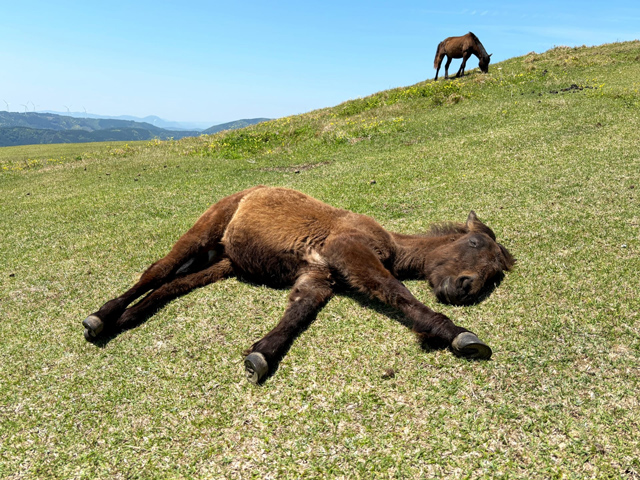
With little human intervention, the Misaki horses continue to live much as they have for generations
Foaling season takes place in April and May, and visitors in the following months may spot young foals basking in the sunshine or frolicking across the open grasslands. The Cape Toi grasslands are managed by the Toi Misaki Ranch Association, whose approach prioritizes the horses’ natural life cycle with minimal human intervention. Aside from routine health checks and controlled annual grass burning to maintain the grasslands, the horses are left to live according to nature’s rhythms. During guided walks, visitors may even notice the sun-bleached skeletons of horses that died naturally, gradually returning to the landscape and becoming part of the ecosystem once again.
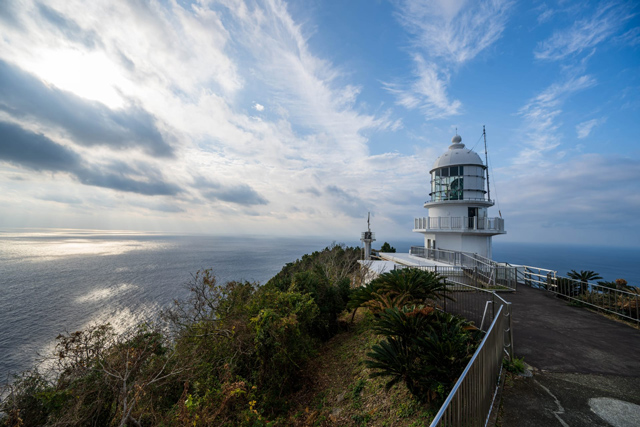
Standing at the tip of Cape Toi, the lighthouse has guided ships along this rugged coastline for nearly a century
Visitors can take in panoramic views from the iconic Cape Toi Lighthouse, built in 1929 to guide ships safely along this rugged coastline. The lighthouse is the only one in Kyushu open to visitors, offering sweeping views across the Pacific Ocean. Nearby stands Misaki-jinja Shrine, founded in 708 and dedicated to the sea deity Wadatsumi-no-Kami. Surrounded by a native sago palm forest, the shrine lends the cape an unexpectedly subtropical atmosphere.
After exploring the headland, visitors can sample local specialties such as award-winning Miyazaki Beef and Miyazaki’s celebrated Taiyo no Tamago mangoes, perhaps accompanied by a glass of locally produced shochu. Like the Misaki horses themselves, these local traditions have been shaped by the landscape over generations, making Cape Toi a place where nature, history and everyday life continue to exist side by side.
For more details, contact DMC Japan to discuss ideas, locations and rates.
Contact Us